When geopolitical tensions rise, the first signs of disruption are usually visible: delayed operations, rising costs, and shifting trade routes.
The more important signals are often harder to detect.
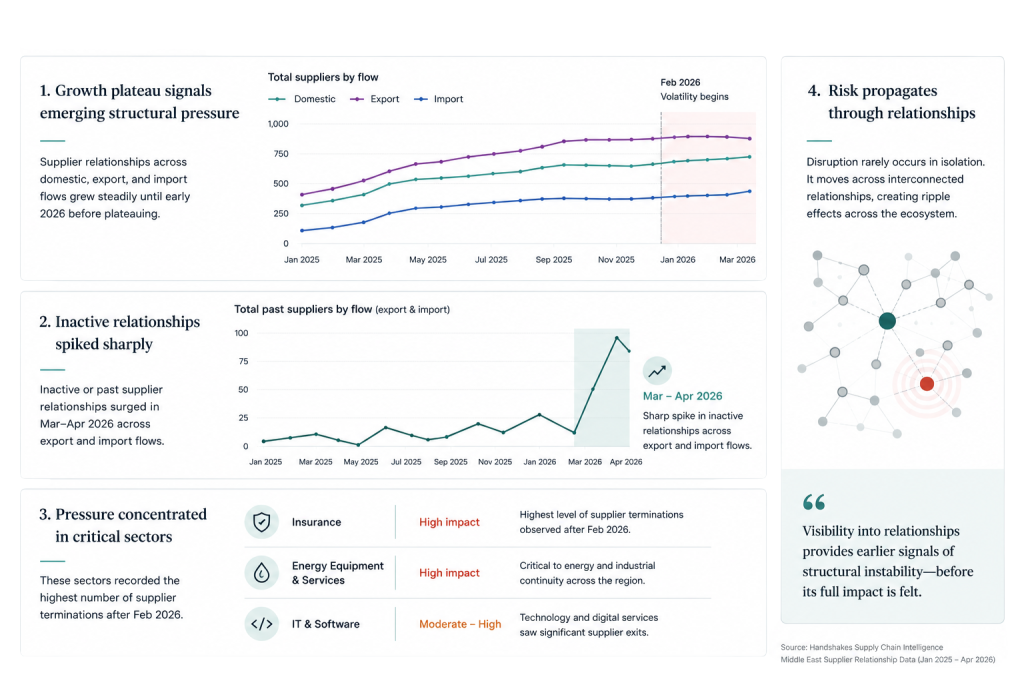
Recent supplier relationship analytics across the Middle East show that changes within supplier networks can emerge long before broader disruption becomes fully visible. While supplier activity remained relatively stable through early 2026, signs of strain began to surface beneath the surface.
Growth across domestic, export, and import supplier ecosystems started to plateau, followed by a sharp increase in inactive supplier connections during March and April 2026. These shifts suggest more than operational disruption. They indicate changing dependencies, weakening commercial continuity, and growing pressure across interconnected networks.
Key signals observed across Middle East supplier relationship data (Jan 2025 – Apr 2026)
The impact was not evenly distributed.
Insurance, Energy Equipment & Services, and Technology-related sectors recorded some of the highest levels of supplier cessation during the period. Given the role these sectors play in supporting trade, operations, and infrastructure, disruption within them can create ripple effects far beyond individual organisations.
What makes these developments significant is not simply that supplier relationships have changed. It is how those changes spread across the broader ecosystem.
Traditional approaches to risk monitoring often focus on direct suppliers and individual entities. However, geopolitical uncertainty rarely affects organisations in isolation. Exposure can emerge through suppliers, partners, affiliates, and other connected entities across multiple jurisdictions.
As networks evolve, so does risk.
This is why visibility in relationships is becoming increasingly important. Understanding how entities are connected, where dependencies exist, and which relationships are changing can provide organisations with earlier signals of instability before wider disruption materialises.
The same principle extends beyond operational resilience. In regulatory environments, including Anti-Money Laundering compliance, organisations are increasingly expected to understand relationships beyond direct counterparties and maintain visibility into evolving networks.
The recent shifts observed across Middle East supplier ecosystems reinforce a broader reality: resilience is no longer defined solely by operational preparedness. It depends on understanding the networks that support business activity and recognising how risk moves through them.
In periods of uncertainty, organisations that can see beyond direct relationships are often better positioned to anticipate change, assess exposure, and make decisions with confidence.
Navigate uncertainty with greater confidence
Handshakes helps organisations uncover relationships, monitor evolving networks, and gain visibility into the connections that matter most. Leveraging intelligence from sources such as the S&P Global Business Relationships dataset, organisations can better understand how risk and opportunity move through their ecosystems and make more informed decisions when conditions change.
Learn more about how relationship intelligence can support better decision-making in an increasingly interconnected world with Handshakes