
An analyst traces the ownership of a corporate counterparty. The chain runs through three holding companies across two jurisdictions. At the fourth step, it arrives somewhere unexpected: an entity already encountered earlier in the chain. The ownership has looped. The original company effectively owns part of itself, through intermediaries that disguise the fact.
Circular ownership is not always accidental, and not always benign. The structures that produce it are sometimes the residue of historical acquisitions or joint ventures. They may also be intentionally structured in ways that make ownership analysis more complex. Either way, the compliance implication is the same: due diligence that does not account for circular structures has a blind spot, and that blind spot is where the harder questions tend to live.
What Is Circular Ownership?
Circular ownership occurs when a chain of entities loops back so that a company effectively holds an ownership interest in itself, directly or through intermediaries. It stands in contrast to a linear ownership chain, where each entity is owned by another entity that sits clearly above it, and the chain terminates in identifiable beneficial owners.
Here is a simple illustration:
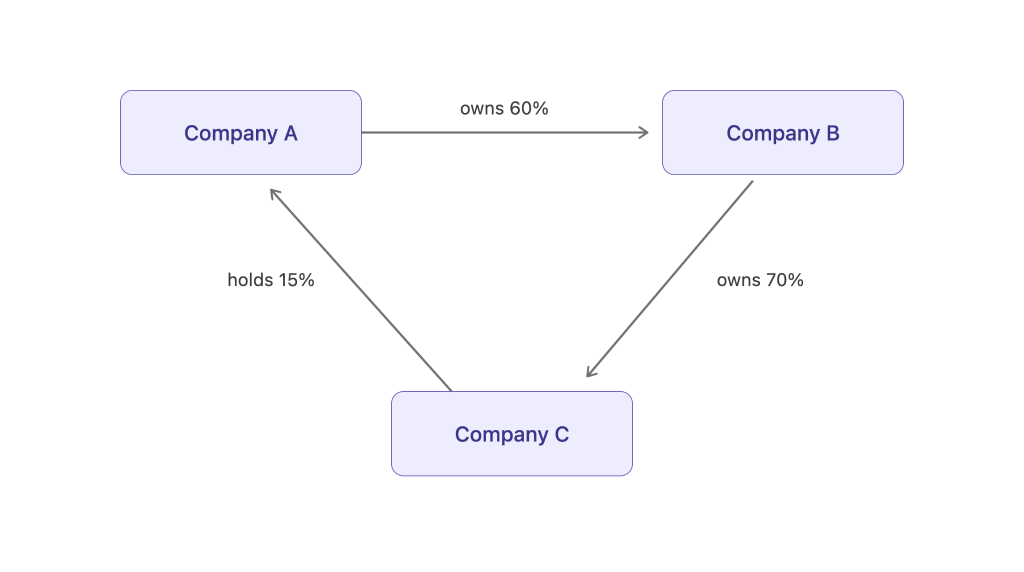
Trace it from any starting point, and it eventually returns to where it began, preventing ownership analysis from easily identifying the natural person typically expected at the end of the ownership chain.
Cross-shareholding is a closely related mechanism. When two or more companies hold shares in each other, mutual ownership ties replace a hierarchy. The effect is the same: control becomes ambiguous, and the chain of accountability hard to draw with confidence.
Why Circular Ownership Exists
Not all circular ownership is fraudulent. Some structures arise organically through historical acquisitions, joint ventures, or legitimate cross-border holding arrangements, in which intercompany shareholdings reflect operational realities rather than concealment.
The same structural feature, though, is also deliberately engineered. Circular structures may make ultimate beneficial ownership more difficult to identify, inflate asset values through reciprocal stakeholdings, enable related-party transactions that appear arm’s-length on inspection, and complicate regulatory tracing across jurisdictions. The intent behind any specific structure may be benign or otherwise. Regardless of intent, complex ownership structures should be assessed as part of a risk-based due diligence process.
This is operational reality, not an indictment of any particular market or industry. The question is whether your due diligence workflow can detect circular structures consistently, and whether they then survive the scrutiny that detection warrants.
The Compliance Risk Hidden Inside Complex Business Ownership Structures
Two distinct compliance risks emerge when an ownership structure loops back on itself: the failure of UBO identification when the chain refuses to terminate, and the dilution of accountability that comes with mutual ownership ties.
When the Structure Is the Red Flag
Circular ownership undermines the identification of beneficial ownership at a structural level. When a chain refuses to terminate in a natural person, the question of who ultimately controls and benefits from the entity becomes one that traditional ownership review methods may not confidently resolve.
That problem sits against current compliance obligations. FATF recommendations, the Monetary Authority of Singapore (MAS) guidelines on beneficial ownership and the broader AML and KYC framework all require firms to identify and verify ultimate beneficial owners. Regulators expect this even when the underlying structure resists it.
Enforcement exposure follows from that expectation. Where beneficial ownership cannot be adequately identified or verified, organisations may face increased regulatory scrutiny and compliance risk. Diligence is the obligation, not the absence of suspicion.
Cross Shareholding and the Problem of Mutual Control
Cross shareholding presents a related but distinct challenge. When two companies hold meaningful stakes in each other, the questions of who controls whom, whether either is genuinely independent, and where conflicts of interest may sit all become ambiguous in ways that linear analysis cannot resolve.
The implications run beyond ownership disclosure alone. Cross-shareholding is a frequent structural mechanism behind undisclosed conflicts of interest in both corporate and public-sector contexts. Two organisations that appear to operate at arm’s length, but in fact own one another, can structure transactions, contracts and appointments in ways that may warrant closer review to assess independence and potential conflicts of interest.
Why Traditional Due Diligence Struggles to Catch It
Traditional due diligence is structurally ill-equipped for circular ownership. Three failure modes recur:
- Jurisdictional silos: Manual registry searches are often limited by jurisdictional boundaries, making cross-border ownership analysis significantly more challenging. A circular chain that spans two jurisdictions will not surface from either alone.
- Point-in-time blindness: Ownership snapshots taken at onboarding miss the structural changes that create or dissolve circular structures afterwards.
- Linear analysis: Human analysts work through chains step by step, in the direction the data presents. Loops are not naturally visible from that vantage point; they emerge only when the chain is traced in full and compared to itself.
APAC compounds all three. Variable registry transparency across Singapore, Malaysia, China, Vietnam and Thailand means a circular structure spanning two or more of these markets is exponentially harder to detect through conventional methods.

Mapping What Manual Review Misses
Detecting circular ownership requires relationship mapping at scale. That means traversing ownership chains across multiple entities and jurisdictions simultaneously, holding the full network in view, and helping identify ownership loops and circular relationships that warrant further review. Manual linear review will not catch it; the structural blind spot is too well matched to how human analysts read data.
Handshakes is built for this kind of work. With its proprietary due diligence software, it combines UBO unwrapping, entity connection mapping and APAC registry coverage across Singapore, Malaysia, Vietnam, China and Thailand to support the identification and analysis of complex cross-border ownership structures at scale.
Detection at onboarding is the starting point, not the finish line. Ownership structures can change after an initial review, reinforcing the importance of ongoing monitoring.
If Ownership Goes in a Circle, Your Due Diligence Needs to Keep Up
Circular ownership is a structural problem, and it requires a structural solution. Firms that rely on linear, manual tracing will consistently miss what is hidden inside the loop, not because their analysts are deficient, but because the method is not built for the geometry. Understanding a business ownership structure today means following every thread, including the ones that double back.
Whether the work runs inside customer onboarding, counterparty review or a wider corporate background check, Handshakes supports organisations in analysing complex ownership structures through relationship mapping, ownership visibility, and ongoing monitoring. Explore how Handshakes can strengthen your due diligence across complex APAC ownership.